Unfinished, primed or pre-finished doors
Finish is usually treated as a style decision. It is really a moisture decision. Timber takes up and gives off water from the air, and an unsealed face lets it do that unevenly across the leaf, which is exactly how a flat door becomes a bowed one.
Last updated
 AI illustration
What is the difference between an unfinished, primed and pre-finished door?
Unfinished doors arrive raw and need finishing before they are hung. Primed doors carry a base coat and still need topcoats. Pre-finished doors are factory coated and ready to fit. Whatever you choose, seal all six faces including the top and bottom edges, or the door will move.
The three options compared
| Unfinished | Primed | Pre-finished | |
|---|---|---|---|
| What arrives | Bare timber or veneer | A base coat, usually white, on a paint-grade door | Fully coated and ready to hang |
| Work still to do | Full finishing schedule, all six faces | Topcoats, normally two | None, beyond sealing any cut edges |
| Colour control | Complete — any oil, stain or paint | Any topcoat colour | Whatever the factory applied |
| Cost of the door | Lowest | Low | Highest |
| Total cost with labour | Often the highest once finishing time is counted | Middle | Frequently the lowest on a whole-house job |
| Finish durability | Depends entirely on the job you do | Depends on the topcoats | Factory conditions are hard to match by hand |
The counter-intuitive line in that table is the total cost. On one door, unfinished is cheaper. On twelve doors, each needing several coats on both faces and all four edges with drying time between, pre-finished frequently wins — and it removes the step most likely to be rushed.
Why does sealing all six faces matter so much?
A door has six surfaces: two faces and four edges. Finish is not only decoration; it is the barrier that slows moisture moving in and out of the timber. Coat five surfaces and leave the top edge bare, and that edge exchanges moisture with the air at a different rate from the rest of the leaf. The door then moves unevenly, and it bows.
The top and bottom edges are the ones that get missed, because the door is standing on one and nobody looks at the other. Coat them before the door is hung, and coat any edge you trim, at the time you trim it.
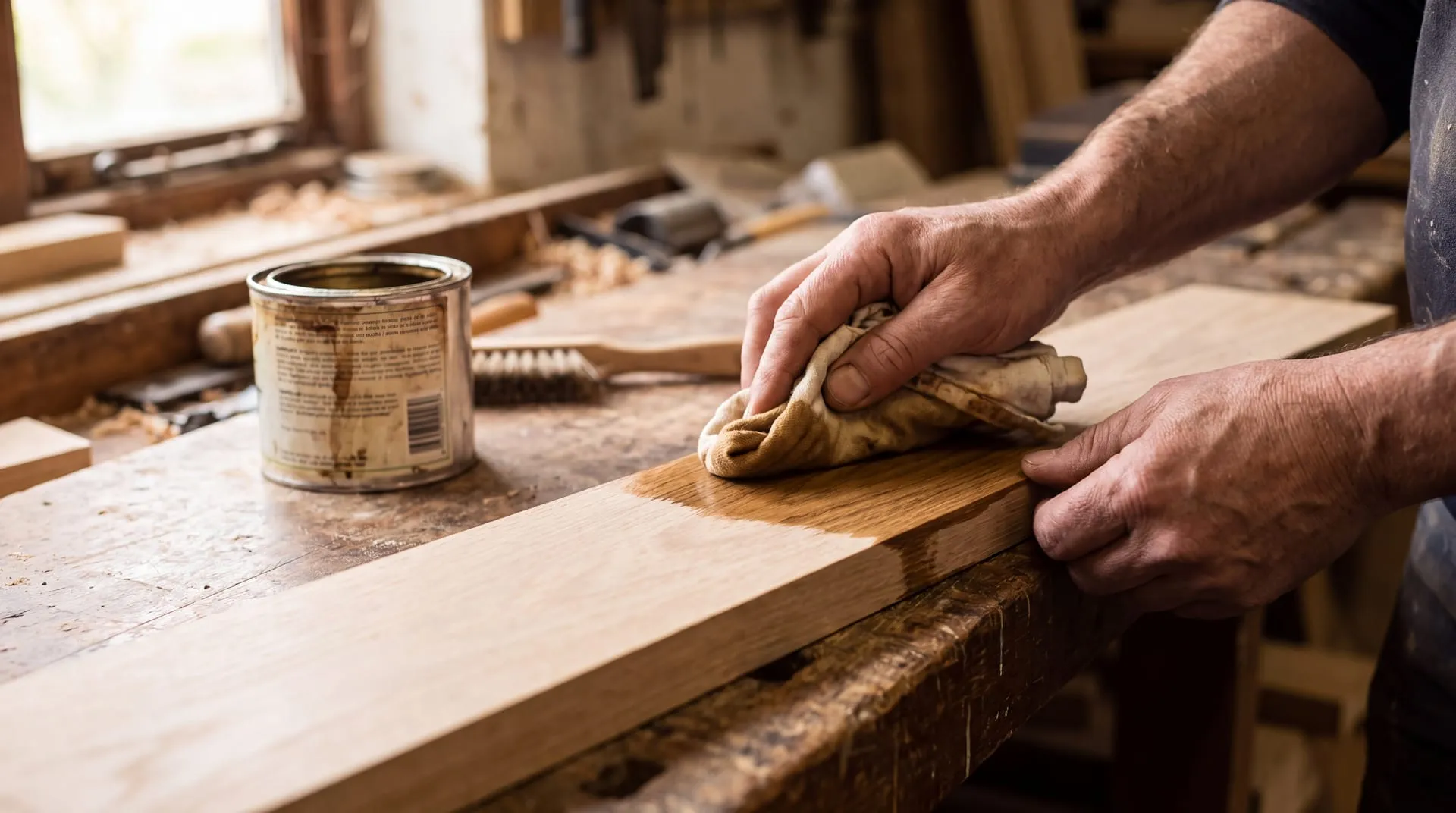
How do I oil an oak door?
Oil soaks into the timber rather than sitting on it as a film, which is why an oiled oak door looks like wood rather than like a coated surface, and why it can be refreshed later without stripping. It is also less hard-wearing than a lacquer, so it wants topping up.
- Let the door acclimatise flat in the room it will hang in, out of direct sun and away from a radiator, before doing anything to it.
- Do any trimming first, so cut edges get oiled with everything else.
- Sand lightly along the grain and remove all dust. Veneer is thin, so this is a light pass, not a levelling exercise.
- Apply a thin, even coat of a door-suitable oil to one face, then the edges, then the other face.
- Wipe off the excess before it becomes tacky. Oil left standing on the surface stays sticky and attracts dirt.
- Allow the drying time on the tin, then repeat for the number of coats the product specifies.
- Hang the door only when the last coat is properly through-dry, not just touch-dry.
What about white primed doors?
A primed door is not a finished door, even though it looks white and clean when it arrives. The primer is a key for the topcoats. Hang a primed door and leave it, and it will mark, absorb dirt at the handle and take up moisture at the edges.
The routine is a light key with fine abrasive, dust off, then the topcoats the paint specifies, on all six faces. Where a door has been factory primed, using a topcoat compatible with that primer matters more than the brand.
Should I finish the door before or after hanging it?
Before, for the edges. The top and bottom edges are effectively unreachable once the door is hung, and those are the two that most need sealing. Trim first, seal the cut edges, then complete the finish, then hang. If the faces are being painted to match the room afterwards, that is fine — but the edges are done first.
Common questions
What does a pre-finished door mean?
It has been coated at the factory and arrives ready to hang, with no further finishing needed beyond sealing any edge you trim on site. Factory coating is applied in controlled conditions that are difficult to match by hand.
Do I need to paint a primed door?
Yes. Primer is a base for the topcoats, not a finish. A primed door left unpainted will mark, take up dirt around the handle and absorb moisture at the edges. It normally needs a light key and two topcoats on all six faces.
Do I have to finish the top and bottom edges of a door?
Yes, and they are the two that get missed. An unsealed edge exchanges moisture with the air at a different rate from the finished faces, which makes the leaf move unevenly and bow. Manufacturers commonly make it a condition of the guarantee.
How many coats of oil does an oak door need?
Follow the product instructions rather than a general number, because oils differ. The consistent rules are thin coats, excess wiped off before it goes tacky, full drying time between coats, and every one of the six faces treated.
Can I paint an oak door?
You can, though it is worth being honest that you are paying for a timber face you will then cover. If the finished look is painted, a primed paint-grade door costs less and takes paint better than an oak veneer does.
Should I let a door acclimatise before fitting?
Yes. Store it flat, in the room it will hang in, away from direct sun and radiators, before trimming or finishing. It lets the timber settle to the moisture level of the room it will live in, so it moves less after it is hung.
Ready to order?
Every door lists its sizes in both imperial and metric, so you can check yours against what you measured before you commit.